

UNIDA Hosts SDGs Talk and Inaugurates SDGs Center, Integrating Sustainable Development into the Pancadarma Program
1 year ago
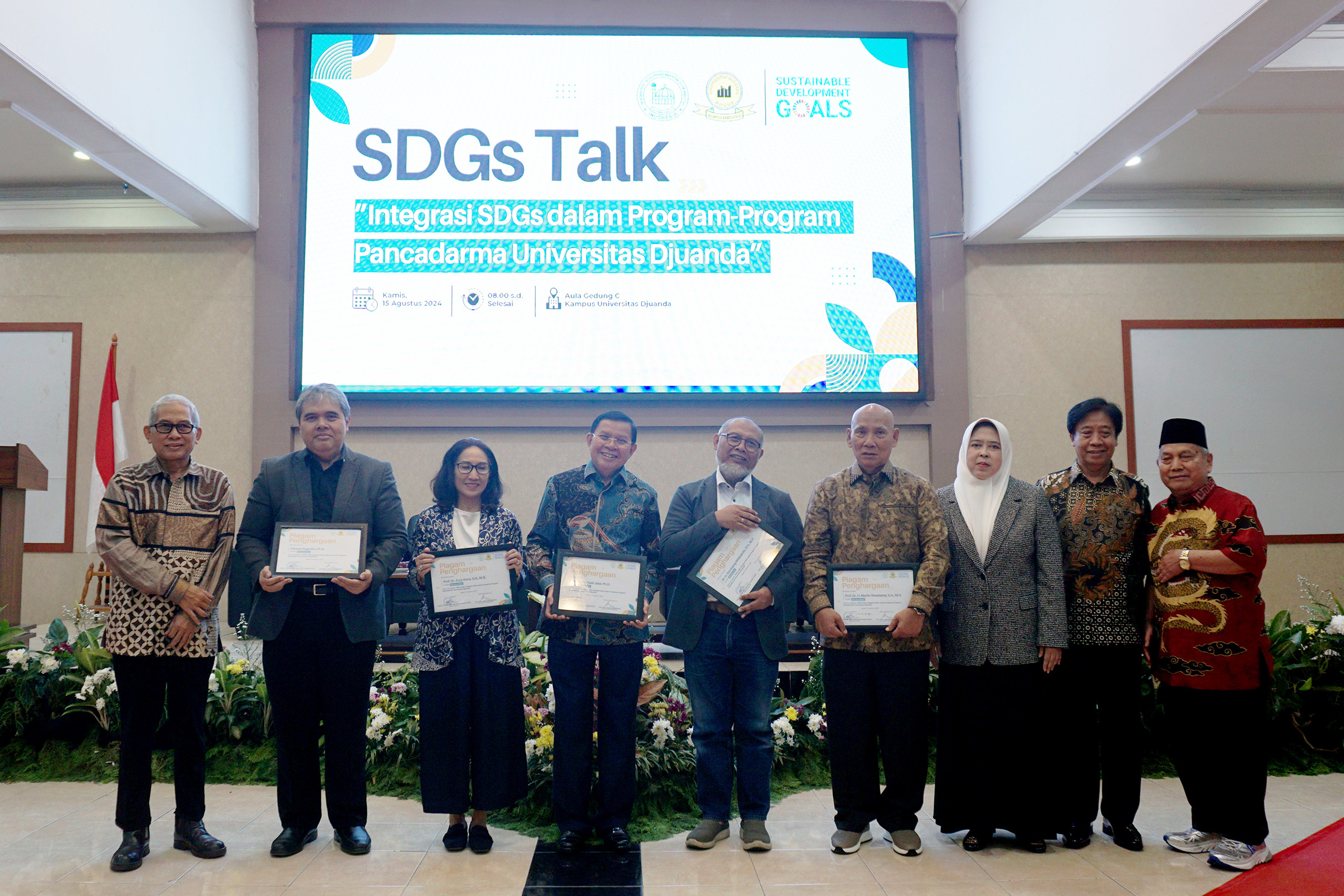
In an effort to strengthen academic contributions towards achieving the Sustainable Development Goals (SDGs), Djuanda University (UNIDA) held an SDGs Talk alongside the inauguration of the UNIDA SDGs Center. The event, themed "Integrating SDGs into Djuanda University’s Pancadarma Programs," took place on Thursday, August 15, 2024, at the Aula Gedung C on the UNIDA campus.
The SDGs Talk featured several speakers, including UNIDA Chancellor Prof. Dr. H. Martin Roestamy, S.H., M.H., who delivered a prologue on "SDGs in the Perspective of Pancadarma at Djuanda University." Another speaker, Yanuar Nugroho, Ph.D., Coordinator of the Expert Team at the National SDGs Secretariat of BAPPENAS, discussed "An Overview of SDGs Implementation in Universities and Indonesia’s SDGs Roadmap."
Meanwhile, Prof. Dr. Zuzy Anna, M.Si, Director of the SDGs Center at Padjadjaran University, presented on "Best Practices for Implementing SDGs in Higher Education Programs." Additionally, Prof. Dr. H. Fasli Jalal, Ph.D., Rector of Yarsi University, talked about "Integrating 5 SDGs into Enhancing the Quality of Higher Education Human Resources." The session was moderated by Dr. Bambang Widjojanto, S.H., M.H., a lecturer at UNIDA’s Graduate School.
The Chair of the UNIDA SDGs Talk, Prof. Dr. Ir. Dede Kardaya, M.Si, stated that the SDGs are an integral part of the 2030 sustainable development agenda, encompassing 17 goals and 169 interconnected targets. In Indonesia, the SDGs have become a national development agenda through Presidential Regulation Number 111 of 2022.
To achieve SDGs targets at the national and global levels, Prof. Dr. Ir. Dede Kardaya, M.Si, noted that the UNIDA High Council (MTU) has established five priority SDGs that are most relevant and achievable by 2030: No Poverty, Quality Education, Gender Equality, Peace, Justice and Strong Institutions, and Partnerships for the Goals.
"Today we will learn together, with the goal of better understanding the SDGs, their interconnections, and the roadmap for sustainable development goals in Indonesia. Moreover, it is hoped that this will inspire us in terms of best practice management and commitment to achieving the five priority SDGs that align with UNIDA's Pancadarma activities," he expressed.
Also present was the Head of LLDIKTI Region IV West Java-Banten, Dr. M. Samsuri, S.Pd., M.T., IPU, who in his speech addressed the role of higher education in sustainable development. He emphasized that the presence of universities as centers of excellence helps the central and local governments in the formulation, implementation, monitoring, evaluation, and reporting of the SDGs Action Plan in Indonesia.
"Higher education institutions should not just fill in, but also actively participate in society. In action, all universities may already be making partial efforts to participate in addressing and resolving concerns regarding the sustainable development goals," he stated.
Dr. M. Samsuri, S.Pd., M.T., IPU explained that universities play a role in producing quality human resources and serve as the core institution of quality education. There are at least two main areas of focus in accordance with the role of higher education, namely improving graduate quality and university productivity.
"If we are concerned about producing quality graduates, this is the most important part, as the crucible for this lies in higher education. Secondly, productivity. How each innovation result can be expressed in scientific writings that can be published for broader benefit. Thus, higher education becomes more productive as part of building civilization," he elaborated.
At the end of his speech, Dr. M. Samsuri, S.Pd., M.T., IPU also symbolically inaugurated the UNIDA SDGs Center.
"Congratulations on the inauguration of the UNIDA SDGs Center; may UNIDA always be a beneficial university for the community and become increasingly prominent," he remarked.
On the same occasion, UNIDA Rector Dr. Hj. R. Siti Pupu Fauziah, S.Pd.I., M.Pd.I expressed that UNIDA envisions becoming an excellent university that enlightens the nation's life, uniting in faith and adhering to international standards. In pursuing its vision and mission, UNIDA has a Pancadarma, consisting of the tridarma of higher education, along with Professionalism and Tauhid (faith).
"What we have been doing has indeed aligned with the SDGs, and today what has been accomplished will be more structured. The presence of our speakers will certainly help us better organize more directed activities," she stated during her remarks.
"In order to achieve UNIDA’s vision of being internationally standardized, global programs are needed. The integration of SDGs into Pancadarma activities at UNIDA represents a tangible commitment to taking part in addressing various global issues," she added.
Meanwhile, Chancellor of UNIDA Prof. Dr. H. Martin Roestamy, S.H., M.H., in his prologue, explained that UNIDA aims for international recognition through its commitment to the SDGs, aligning all Pancadarma activities with the SDGs goals and enhancing global academic reputation through character values based on faith.
Prof. Dr. H. Martin Roestamy, S.H., M.H. revealed that there are four stages in achieving these goals: producing scientific articles in reputable journals, applying SDGs principles in every aspect of the university's Pancadarma activities, internalizing the 5S principles—Sadar Unggul (Excellence Awareness), Sadar Prestasi (Achievement Awareness), Sadar Sinta (Sinta Awareness), Sadar JAD (JAD Awareness), and Sadar Diri (Self-Awareness)—and establishing appropriate university ranking targets through research, teaching, and institutional development strategies.
"The implementation of a planned and directed strategy will play a crucial role in achieving these targets and enhancing UNIDA's position on a global scale," concluded Prof. Dr. H. Martin Roestamy, S.H., M.H.